
Integrating Civic Learning and Democracy Across our Schools and Colleges: Examples from the PDTS Course Planning Retreat
U-M faculty across the disciplines contribute to the public purpose of higher education to prepare students for citizenship


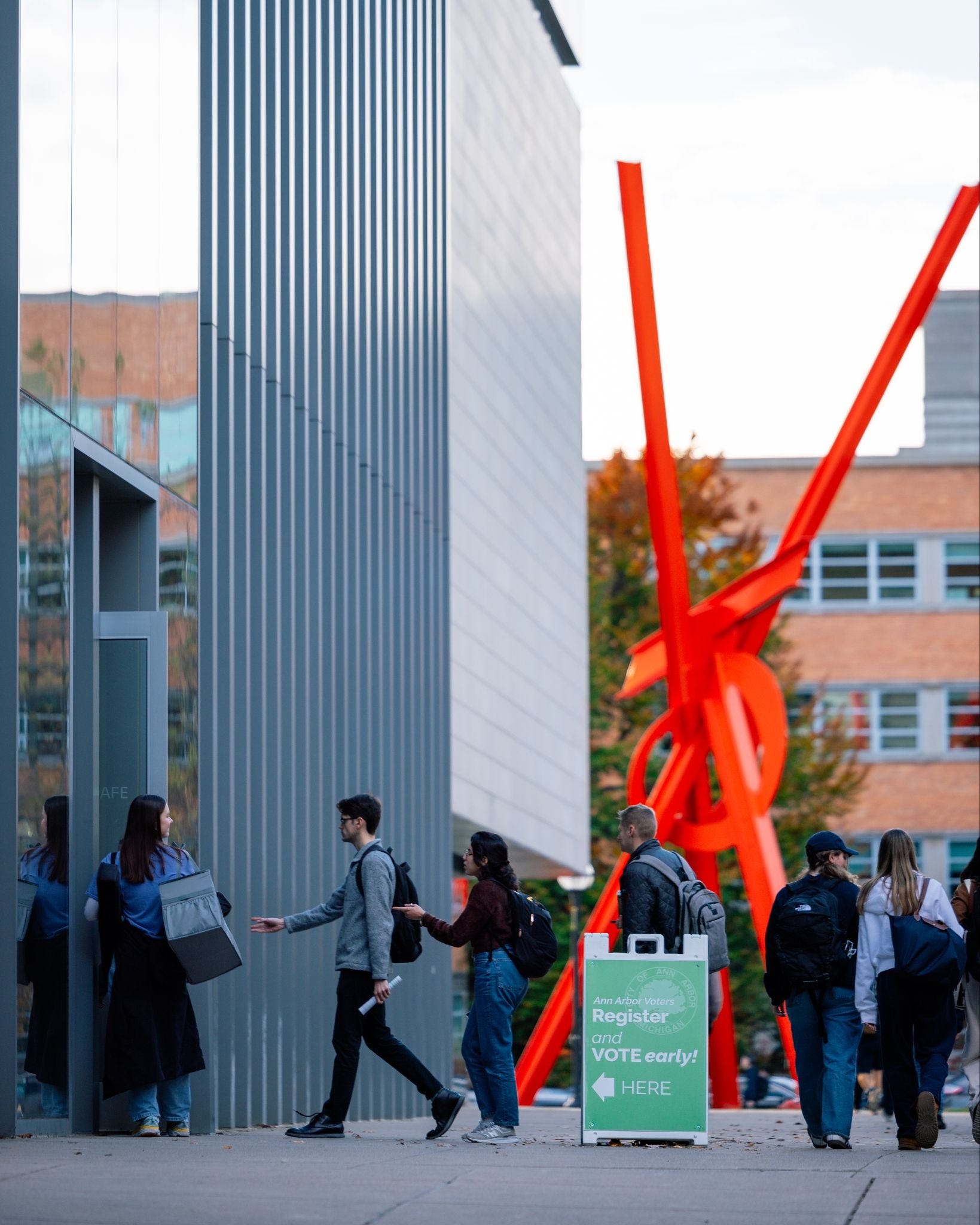
This piece is part of CRLT and the Edward Ginsberg Center’s partnership to offer programming and resources for instructors around democratic and civic engagement through the Promoting Democracy Teaching Series (PDTS).
If you went to high school in the U.S., your civics education likely started and ended with a required government or civics class. This siloed model frequently carries over into higher education; students in STEM, business, the arts, and other fields may satisfy a general education requirement with a history or politics elective, and that constitutes the extent of their undergraduate civic learning.
So, when organizations like the AAC&U and Campus Compact share their vision that every undergraduate in every degree program develops the knowledge, skills, and commitment to participate in our democracy and civic life, they are proposing a departure from the norm, an integrated model. And, as hopelessly earnest as this will sound, I believe in that vision—that civic learning and democratic engagement belong in university courses across the curriculum, and throughout an undergraduate experience.
Here’s the thing, though: I’m a political scientist by training. Of course I’m going to tell you that preparing students for citizenship is some of the most important work we do in higher education—I’m the carpenter with a hammer that thinks everything is a nail. It’s easy for me to say that instructors can integrate civic learning and democracy into their courses and curricula—it fits so naturally into mine! To borrow from my home discipline (and economics), it’s “cheap talk,” coming from me.
So I thought that, in this piece, I could let other instructors’ work do the talking. In August 2024, CRLT and the Edward Ginsberg Center, U-M’s center for civic and community engagement, collaborated to offer the first Promoting Democracy Teaching Series (PDTS) Course Planning Retreat. The retreat brought together 34 faculty members across 10 schools and colleges, and they developed such thoughtful and creative ways to bring democracy and civic learning into their Fall 2024 courses. Our PDTS team wanted to introduce you to some of the incredible work that came out of the retreat, particularly as we plan our second PDTS Course Planning Retreat for this August, thanks to the support of the Initiative for Democracy & Civic Empowerment.
The projects below demonstrate how faculty navigated different constraints to make civic learning possible in their courses. They also illustrate a rich, multi-faceted conceptualization of civic learning and show how every discipline develops specific skills that are vital for a healthy democracy, whether it’s quantitative reasoning, critical inquiry, communication, collaborative problem-solving, or creative expression. Perhaps more than anything, though, these examples highlight what’s gained when citizenship and democratic engagement are made tangible and relevant to students across their coursework.

Empowering New Voters
Our PDTS team—led by Assistant Director Meg Stowe and me at CRLT and Associate Director Kate Livingston at Ginsberg—planned the retreat with the 2024 U.S. Presidential Election in mind. Like many college campuses, there is always a lot of energy around national elections. They are focusing moments, where the importance of democratic and civic engagement is readily apparent. Many undergraduates at U-M are newly eligible to vote. We know, though, that young adult voters don’t participate in elections at the same rates as other generations. Communicating information widely on how to participate in an election, correcting myths about voting, and removing structural barriers to student voting have a direct impact on the youth vote. It’s why the work of UMICH Votes is so important.
Instructors are well-positioned to add to this work. For example, faculty can help motivate voting through learning experiences where students make connections between their choices on the ballot and important issues in their communities. Stephen Raiman, an assistant professor in the College of Engineering, did this in his Introduction to Nuclear Engineering course. After the PDTS Course Planning Retreat, Raiman developed a writing assignment where students selected a 2024 electoral race and analyzed how the outcome of the race might affect nuclear energy issues. Raiman highlighted the opportunity to consider Michigan races and ongoing decisions around the Palisades Nuclear Power Plant.
Faculty can also help students feel more confident and well-informed as voters. Scott Beal, a lecturer in the Sweetland Center for Writing, teaches a first-year writing course, where students develop their understanding of rhetoric and argumentation. After the 2024 retreat, he asked students to turn their attention to the rhetorical choices made by political campaigns in their advertisements in a homework assignment. In addition to strengthening their understanding of rhetoric more broadly, the assignment also encouraged students to become more critical consumers and interpreters of campaign information.
Both of these cases highlight how faculty can support students as voters in ways that were highly relevant to the course and discipline.


Civic Professionalism
Of course, voting is just one part of civic life. While an election can be an important catalyst, citizenship involves an on-going engagement in our communities and with the complex public challenges they face. One way that many of us make these kinds of contributions is through our professional roles, using the skills and expertise we developed in them—a practice often described as civic professionalism.
It can be hard, however, to make space for this in our curricula. As Grace Kanzawa-Lee, an clinical assistant professor in the School of Nursing, recently put it: “Nursing sometimes has a tendency to get buried in our silo. [We become] so worried about equipping our students to act as clinicians that we forget about how nurses are essential citizens who are impacted by and can significantly impact policy on local to international levels.”
At the PDTS Course Planning Retreat, Kanzawa-Lee and others explored practical ways to build on their students’ burgeoning professional identity to foster a civic one. She developed an assignment for undergraduate nursing students where students identified an instance where their own views on a health policy did not align with the law or government actions. They investigated an argument for and against the law or action and assessed the evidence. Drawing from the American Nurses Association’s standard that nurses “use their voices to advocate for transformative action-oriented policies and initiatives,” students then reflected on the question: What is your duty as a professional nurse if your own views do not align with evidence-based practice and/or governmental policies?
Similarly, Nitesh Singh, a lecturer in the School of Social Work, asked students to engage with the National Association of Social Workers’ Code of Ethics around the responsibility of social workers to engage in social and political action to support the “general welfare of society” and the “development of people, their communities, and their environments.” His students reflected how this responsibility may play out in their own social work practice and how to balance their personal political beliefs with their professional responsibilities.
Not having a degree from a professional school, it was a bit of a revelation for me to see how faculty could draw on nationwide professional associations to establish that civic participation is part of what it means to be in their fields. It actually inspired an assignment in my own class this semester. That said, the civic role of a field or profession may not always be explicitly laid out. In cases like that, faculty can draw these links by sharing the civic contributions of individuals or groups in the field.
For example, M’Lis Bartlett, a lecturer in the School for the Environment and Sustainability, left the PDTS Course Planning Retreat with a renewed motivation to prepare students for careers where they will collaborate on complex public challenges with people who have differing experiences, stakes, and views.
Bartlett decided to invite two guest speakers to her Fall 2024 course on the Science and Practice of Social Change. These were colleagues in the field with experience communicating about climate change and wind energy in rural communities, where community members may not agree politically or accept the scientific research on climate change and renewable energy. These speakers reinforced the relevance of the science communication skills they develop in SEAS and provided an opportunity for students to reflect on the civic skill of how to talk, listen, and collaborate with people with differing experiences, stakes, and views on important public issues.
We don’t enter adulthood simply holding a civic identity— in fact, developing a civic identity and commitment is a critical competency in AAC&U’s VALUE rubric for undergraduate learning around civic engagement. These examples highlight how faculty can provide learning experiences that develop these commitments alongside their growing professional identities.

The Humanities’ Civic Tradition
With my training as a quantitative social scientist, I probably learned the most from the classroom ideas shared by faculty in the humanities at the PDTS Course Planning retreat—how ancient and pre-modern literature, art, philosophy, and history can build civic virtue and civic skillsets today. Benjamin Paloff, a professor in comparative literature, showcased the relevance of the humanities to contemporary democracy in his Philosophy of Literature senior seminar. In fact, he made them relevant to very local public debates. In light of the presidential election and U-M’s Year of Democracy, Paloff focused the 2024 iteration of the seminar on political philosophies, including Liberalism, Authoritarianism, and Marxism. Throughout the term, his students assessed real dilemmas of democracy at U-M, including the University’s policy on free speech and academic expression and the University’s investment and divestment policies, using the philosophical models they read in the course.
Dr. Netta Berlin in Classical studies also drew these links through a major course project first-year seminar about dissent in Greek mythology, which focuses on two figures of resistance in Greek myth, Prometheus and Antigone. After the retreat, Berlin asked students to consider how the Greek tragedy Prometheus Bound contributed to modern political theory and to an innovative public arts project on criminal justice and the penal system. Berlin recently shared with us the outcome of this redesign:
Students grappled with the complexities and contradictions of each myth in relation to the principals, practices, and problems of democratic Athens in the 5th century BCE and, from there, of American democracy.
It’s hard to put the humanities’ civic impact better than she has!
Berlin also wanted to ensure that the experience felt personally relevant, so “within this framework, students also looked to their future, envisioning ways in which their college education could help them build and act on their sense of citizenship.”
Our team felt all the more motivated to provide a 2026 iteration of the PDTS Course Planning Retreat after hearing how the 2024 program supported this redesign. Berlin shared how the retreat “afforded me the environment, tools, and resources to think critically and creatively about the redesign of my first-year seminar.”
Wrapping Up
I don’t want to wrap up! We have another 20+ great ideas to share with you from U-M faculty across the University who participated in the retreat. We haven’t talked about projects from our faculty who teach programming in the School of Information, who really epitomized how to integrate democracy when the course schedule isn’t very flexible. I want to share all the creative, authentic assessments faculty developed, where students prototyped a new installation for our Campus Voting Hubs, pitched a community event on electoral participation for Latinx Heritage Month, and created get-out-the-vote 8 frame animations. Yes, I am cheating and trying to sneak more in, but academics aren’t known for our brevity!
In sharing these ideas, I hope to emphasize what’s possible to our readers across higher education. In the short-term and on the individual instructor level, these classroom activities and assignments—and the underlying civic and democratic learning goals that motivated them—may generate ideas for how you’ll approach your teaching during the upcoming 2026 Midterm Elections.
On a larger scale, they plant seeds for how we might enact the Civic Learning and Democratic Engagement Coalition’s vision to move institutions towards curricula where democracy is a shared, cross-disciplinary responsibility. Because, look, I know I joked earlier about how I’m the political scientist with a hammer who thinks everything is a nail. Actually, I’m the political scientist with the hammer who thinks every structure is going to need a hammer. That is, our communities—whether at the local, state, nation, or global level—have some important and complex challenges to face together. When we foster civic knowledge, skills, and values in our students throughout their undergraduate experience and within the context of their majors, we equip them with vital tools to tackle the challenge(s) they most care about, as contributing members of a pluralistic society.
__
With leading scholars of democracy concluding that we’re in the midst of a “dramatic reversal” of “almost all aspects of democracy” across the world, it’s really an understatement to say that this vision is more important than ever.
 | A guest post by
|