
Changing It Up on U-M's campus

October 13, 2014
After many months of preparation, U-M Student Life and the Educational Theater Program launched a major new initiative this fall to promote a welcoming campus climate for diverse students. If you’re teaching first-year undergraduates, your students will very likely attend a "Change It Up!" training this month, where they will learn about bystander intervention strategies to promote safe and respectful communities on campus.
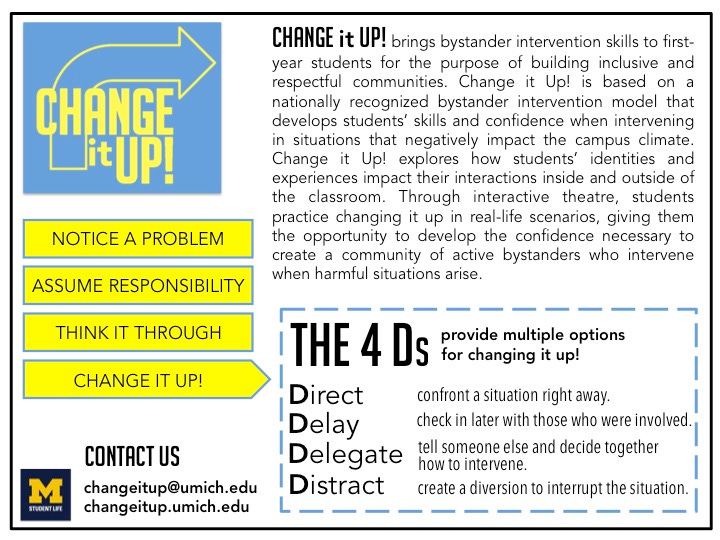
Based on a nationally recognized bystander intervention model, the Change It Up! program is organized around several key goals, including:
encouraging students to recognize themselves as members of a campus community where individual behaviors can collectively have a powerful effect upon broader campus climate
increasing students' awareness of language and behavior that disrespects or excludes some campus community members based on their social identities
building students' skills and confidence at intervening effectively in potentially harmful situations.
The program highlights strategies a bystander can use to intervene in discrimination, disrespect, and even interpersonal violence. As highlighted in the image, these are represented by the “4 Ds” of Direct, Delay, Delegate, and Distract.
U-M teachers might be especially interested in the "Delegate" strategy. In this bystander intervention option, students are encouraged to turn to other people who can be resources or allies when they witness or feel targeted by language or behavior that insults or excludes members of the campus community. The workshop identifies instructors as one group of people to whom students might delegate and with whom they might strategize an effective intervention.
As a teacher, how might you prepare yourself to respond should such a request come your way?
See Change It Up! The program is offered to student groups of about 100, and instructors are welcome to attend a workshop if they want to see first-hand the discussion and skill-building that happens during the session. The current schedule can be found here.
Educate yourself about microaggressions and their effects. Columbia psychology professor Derald Wing Sue has published extensively on the topic. This Psychology Today article pulls from his scholarly work to address the common assertion that people of color are being "oversensitive" when they name racial microaggressions as such. Like the "Change It Up!" program, he emphasizes the harmful effects of seemingly small, even invisible, identity-based slights that accrue over time.
Take advantage of campus resources. CRLT consultants are available to think through any teaching challenges with you, including occasions when you witness or are alerted to a bias incident in your class. You can call us at 734-764-0505 during business hours or request a consultation online. The Spectrum Center provides ally development training throughout the semester. The Common Groundprogram provides workshops for groups on working effectively across different social identities.
Proactively cultivate inclusive classroom communities. Teachers can influence campus climate by explicitly naming respect and inclusivity as key values of our campus learning environments--and talking with students about specific behaviors that convey respect. These CRLT pages address specific teaching strategies that foster inclusivity.